
Story · 7 min read · 13 July 2026
Six Failed Products, One Control Ops: This One is Parth Makwana's Path

Every founder has a version of this story: an idea that seemed obvious in the moment, months of work poured into it, and then the quiet, painful decision to shut it down. What separates founders who fold after that moment from founders who go on to build something real is rarely talent — it's what they do with the failure.
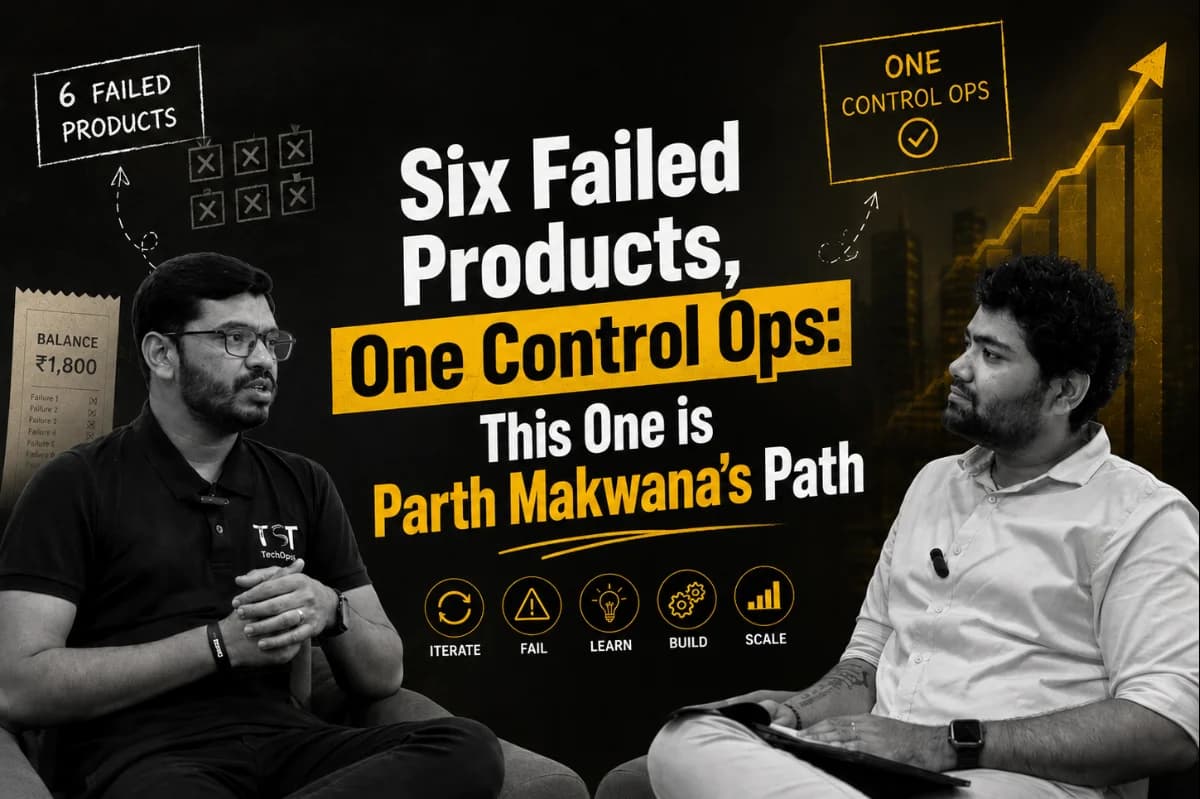
In this episode of FounderTube, we sat down with Parth Makwana, co-founder of TST and Control Ops, to talk about exactly that. Not the highlight reel — the actual mechanics of building a company: the first ₹100 profit, the first big client, the product that had to be killed after burning ₹30 lakhs, and the framework he now uses before starting anything new.
If you're building your first SaaS product, sitting on a failed idea and wondering whether to try again, or trying to figure out how startup grants in India actually work in practice — this one's for you.
The College Side Hustles Nobody Talks About
Before TST or Control Ops, Parth's entrepreneurial instincts showed up in engineering college in forms most founders would never put on a LinkedIn bio: network marketing, selling replicas of branded shoes and clothes, and running a perfume startup — alongside stints across tech startups, digital marketing, delivery companies, and angel firms.
The money wasn't glamorous. First sales brought in roughly ₹100 profit on ₹300–400 worth of goods. But those early margins taught him something that ends up mattering more than the money itself: how to sell, how to manage cash, and how to keep a little discipline going even when the numbers are tiny — he was putting ₹500 a month into SIPs even at that stage. It's a small detail, but it says a lot about the mindset behind everything that came after.
The First Big Client and Payment
The real inflection point came later — not through cold outreach, but through consistent, self-initiated networking on LinkedIn. That effort eventually landed the first big client order, worth over ₹1.5 lakhs — a very different number from the ₹100 profits of the college days, and proof that the same instincts scale if you keep showing up.
By the time Control Ops was started, the founding capital was almost comically lean: ₹1,800, just enough to cover hosting and a domain. Everything after that — early growth, first users — came from organic outreach, social selling, and referrals, not paid acquisition.
Why Control Ops Exists
Control Ops was built to solve a problem Parth saw up close: IT service companies juggling 5–8 projects, each with multiple Linux servers, with no real visibility or centralized control. Developers and DevOps engineers were commonly managing 20–30 servers manually — tracked in Excel sheets or notepads, with no secure, simple way to consolidate access.
The design decisions that came out of that problem are the real spine of the product:
Control Ops runs 100% locally on the user's own device.
It uses a Bring Your Own Key (BYOK) model — no server credentials or API keys are ever stored on Control Ops's own servers.
This isn't a minor technical footnote — it directly addresses the legal, security, and trust barriers that stop IT companies from handing server access to a third-party tool in the first place.
The target customer is deliberately narrow: small to medium IT service companies (5–50 employees) running Linux-only environments. There's currently no support for enterprise clients or Windows servers — a conscious trade-off, not an oversight.
On pricing, the team made a specific call not to charge by server count, keeping the product accessible even as usage scales, rather than letting per-server pricing erode the value for growing customers.
The early numbers validated the bet: 15 signups at public launch, a #5 rank on Product Hunt, and early users from as far as Hong Kong, China, Indonesia, Japan, and the US. Paying customers showed up within 1.5 to 2 months of launch.
The Part Founders Rarely Talk About: Killing a Product
Control Ops wasn't the first product. It was the seventh — six products came before it, and the most instructive failure among them was ToolPlate, a directory consolidating AI tools by category (writing, design, development, and more).
ToolPlate ran for a year and a half. It burned through ₹30 lakhs. And in the end, there was no real business model underneath it — traction never turned into revenue that justified continuing. The decision to shut it down came down to a simple, uncomfortable principle: obsess over customer impact and real traction, not the sunk cost of eighteen months of work. That pragmatic, unsentimental analysis is what eventually redirected focus onto Control Ops.
What Actually Keeps Founders Going
Parth's advice for early-stage founders isn't the usual "just believe in yourself" — it's operational:
Secure financial stability first. Cover your own and your family's basic needs before taking on startup-level risk.
Build a real emotional support system, and treat risk tolerance as something you develop deliberately, not something you either have or don't.
Keep a minimum of one year's runway in reserve to survive the inevitable hard stretches.
Founder chemistry matters more than most people admit — spending informal, unstructured time together (cafes, movies, no agenda) is part of what keeps a founding team cohesive when things get hard.
On splitting resources between the consultancy/service business and product development, the team runs distinct, clearly owned roles: a CTO driving technical direction, with dedicated leads for marketing, sales, partnerships, and SEO. Healthy cash reserves are what make it possible to keep funding R&D without product development becoming the thing that gets cut first when times are tight.
Incubation and Startup Grants in India — The Unfiltered Version
This is one of the most candid parts of the conversation, and it's rarely discussed this openly. Parth's team went through two incubation programs — one turned out to be little more than a WhatsApp group, offering no real structural support. The other, a Gujarat government accelerator, delivered actual value: grants, sponsored support for expos, and help securing lifetime deals.
But the system has real friction:
Grant disbursal is slow — commonly taking 6–8 months to actually receive funds.
Hackathon prize money has, in some cases, taken over a year to be paid out.
Grant amounts themselves are small — typically ranging from ₹2.5 lakh to ₹10 lakh — which isn't enough to meaningfully extend a startup's runway.
Parth's suggestions for what would actually improve the system:
Cut the bureaucratic layers slowing down approvals.
Build clearer mentorship frameworks structured around the core pillars that actually determine startup success: Sales, Delivery, Finance, Team, Distribution, Marketing, and Innovation.
Align grant sizing with actual growth potential and capability, rather than spreading small amounts thin across many applicants without real depth of support.
There are indirect benefits too — subsidies on devices, office rent, utilities, and tax relief — but awareness and accessibility of these programs remain a real gap in the founder community.
The Numbers Behind the Journey So Far
Some context for where all of this has landed: across seven products (including client projects), the ecosystem Parth has been part of now serves over 2.5 million users, with collective client product valuations exceeding $60 million, and direct employment for 25–30 people — with supply-chain effects reaching well beyond that.
For Control Ops specifically, the one-year goal is concrete: 2,500 to 3,000 paying customers, acquired primarily through organic channels — Twitter/X, Reddit, and SEO — rather than paid growth. There's no rigid long-term roadmap beyond that, deliberately: the market is unpredictable enough that the focus stays on incremental growth and continuous product improvement rather than fixed multi-year targets.
The Filter for Product #3
For any founder currently sitting on a failed Product #2, Parth's advice before building a Product #3 comes down to research discipline:
Do deep market and competitor research before writing a line of code.
Aim for at least 80% uniqueness in what you're building — or, if that's not realistic, identify strong competitors already generating $4–5 million annually and study what they're doing right instead of guessing.
Study competitors against the same seven core business pillars — Sales, Delivery, Finance, Team, Distribution, Marketing, Innovation — rather than just their product.
Use accessible tools (LinkedIn, AI research tools) to gather signal, while accepting upfront that complete certainty before launch is never actually possible.
🎥 Watch the full episode on FounderTube to hear this in Parth's own words, timestamped chapter by chapter so you can jump straight to the part most relevant to where you are right now.
Want to Share Your Founder Story on FounderTube?
FounderTube exists because founders learn faster from each other than from theory. If you've built something, failed at something, or are in the middle of a decision that would help other founders make theirs — we want to hear about it.
We're not looking for polished pitch-deck stories. The episodes that resonate most are the ones like this one: real numbers, real low points, and decisions founders had to actually sit with — down to the ₹1,800 it took to start and the ₹30 lakhs it cost to learn when to stop.
If you're a founder with a story worth telling, whether it's your first sale, a product you had to kill, or a system you built that others could learn from - reach out to the FounderTube team about coming on the podcast. We'll handle the format; you just need to be honest about what actually happened.
Subscribe to FounderTube for more conversations with founders building real businesses — not just raising rounds.
Enjoying this story? Sign in to react and follow founders in your feed.
Featuring in this article
