
Story · 6 min read · 1 July 2026
The New Funding Rule of 2026: Investors Want Fewer Startups, Bigger Winners

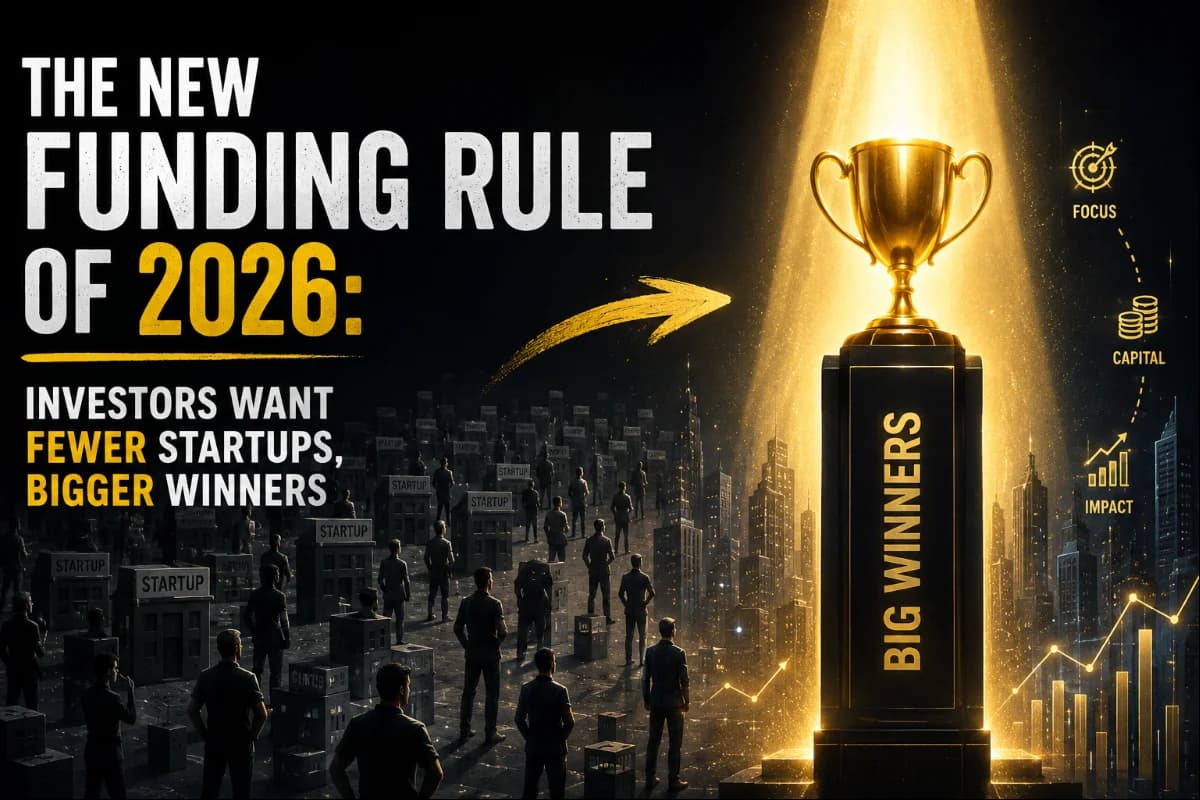
For years, the unwritten logic of venture capital was simple: spray capital across as many promising bets as possible, because the next Google or Stripe could come from anywhere. That logic has quietly died. In 2026, the venture industry has rewritten its own rulebook, and the new rule is brutally simple: fund fewer companies, write bigger checks, and concentrate conviction at the very top.
The numbers make the shift impossible to ignore. Global venture funding hit $285.5 billion in the first quarter of 2026 alone, the highest quarterly total ever recorded. But deal volume fell 15% quarter-over-quarter to roughly 7,000 globally, the lowest level since late 2016 and 61% below the 2022 peak. More money. Far fewer recipients. That is the entire story of venture capital in 2026, compressed into two numbers.
Venture capital didn't dry up in 2026. It just stopped spreading itself thin.
The Barbell Has Become the Whole Market
Industry analysts now describe 2026 as a "bifurcated" or "barbell-shaped" market: massive late-stage rounds concentrated in a handful of mostly AI companies on one end, disciplined early-stage bets on "pre-consensus" opportunities on the other, and almost nothing in between. SVB's State of the Markets report put it starkly: if 2021 was about velocity and 2022–2023 was about triage, the start of 2026 feels surgical — fewer deals, bigger checks, conviction concentrated at the very top.
The "mushy middle" — companies with decent but unremarkable growth metrics, the kind that once raised comfortable Series Bs on momentum alone — has effectively disappeared. Only 13% of Series A companies managed to raise a Series B within 24 months. The funnel hasn't just narrowed. It has been redesigned to filter out everyone but the outliers.
AI Didn't Just Dominate Venture Capital. It Reshaped the Entire Allocation Model

The scale of AI's gravitational pull on capital in 2025 and 2026 is staggering. AI companies captured 65% of all venture deal value in 2025, up from 46% the year before. Total AI investment reached $339.4 billion — the second-highest annual total ever recorded. In Q1 2026 alone, a single $122 billion round for OpenAI accounted for 43% of all global venture funding that quarter. Even stripping that one deal out, investment still topped $163.5 billion, the strongest quarter since early 2022.
Mega-rounds of $100 million or more accounted for 86% of all dollars deployed globally in Q1 2026 — almost entirely within AI-related companies. Anthropic raised $30 billion. Waymo raised $16 billion. xAI raised $7.5 billion. Valuations followed: OpenAI reached $840 billion, Anthropic hit $350 billion, and SpaceX became the first private company to cross the $1 trillion mark.
Meanwhile, the number of active global investing firms dropped 10% to roughly 10,000 — the lowest level since mid-2020. Fewer investors. Fewer deals. Astronomically larger checks. This is not a temporary anomaly; it is the new operating model.
"We're Looking to Make Slightly Fewer, More Concentrated Bets"
That line, from a venture investor speaking to TechCrunch about the outlook for 2026, captures the new institutional posture almost word for word. Funds are explicitly telling founders and LPs that concentration is now a strategy, not a constraint. As one investor put it: capital continues to concentrate in a select number of winners, so we focus on being selective and operationally supporting our companies to earn our right to concentrate.
This represents a fundamental change in how venture firms see their own job. The old model rewarded breadth — more shots on goal, more chances to catch the next outlier by accident. The new model rewards depth: fewer shots, but each one loaded with enough capital, ownership, and operational support to force the outcome. Funds are no longer hoping a portfolio company becomes a category winner. They are trying to manufacture one.
Capital Isn't Gone. It's Just Hoarded by the Few
Here's the detail that gets buried under headlines about "VC drying up": nearly $300 billion in dry powder remains in the system, and over half of it sits with funds of $500 million or larger. These mega-funds are not sitting on the sidelines — they are the ones most active at seed and early stages, increasingly squeezing out smaller and emerging managers who once filled that space.
The consequence is brutal for new fund managers. First-time and emerging managers raised almost nothing in 2025. If you are a founder without access to one of the established, brand-name funds, your odds of getting funded have not just gotten harder — they have gotten structurally harder, because the gatekeepers themselves have consolidated.
Geography compounds the effect. The San Francisco Bay Area and New York City alone captured roughly 64% of all U.S. venture capital deal value in 2025. Being physically or relationally close to those hubs has become, once again, a meaningful predictor of funding success — a reversal of the brief, pandemic-era flirtation with geographic dispersion.
The Uncomfortable Math: 0.05% of Deals, Half the Money
Perhaps the single most telling statistic of the 2026 funding environment is this: about half of all U.S. venture deal value in 2025 went to just 0.05% of all deals. Read that twice. It is not a typo. A vanishingly small fraction of companies are absorbing roughly the same dollar volume as every other startup combined.
This is winner-take-most economics applied directly to the fundraising process itself, long before any company has proven it can actually win its market. Investors are pre-selecting winners at the term sheet stage, not waiting for the market to decide.
What This Means If You're Not One of the Chosen Few
For founders outside the AI infrastructure and frontier-model elite, the implications are sobering but not hopeless. Corporate venture capital has followed the same script — median CVC check sizes rose 35% year-over-year, with corporations consolidating into fewer, larger, higher-conviction bets rather than the scattershot small checks of 2023–2024.
But there is a genuine opening within the squeeze. Roughly 67% of U.S. VC dollars still flow outside the top 1% of companies the market is chasing. Early-stage investing, in particular, "thrives on discipline and finding pre-consensus bets" — meaning investors willing to back genuine outliers early, before consensus forms, are finding an improved signal-to-noise ratio precisely because the market has thinned out the mediocre middle.
The advice converging across nearly every 2026 venture outlook report is consistent and worth internalizing:
Show category-winner potential, not just market size. TAM slides no longer move anyone; evidence of explosive, defensible momentum does.
Build a survival narrative, not just a growth narrative. The better fundraising question in 2026 isn't "why is your market large" — it's why will you be one of the few companies left standing once your sector consolidates.
Map a small, high-fit investor list rather than mass outreach. Thirty to fifty targeted investors with genuine thesis alignment will outperform two hundred cold emails.
Have an AI story that is real, not decorative. Investors are explicitly screening out shallow "AI wrapper" claims faster than they did even a year ago.
Treat warm introductions and investor fit as the new currency. In a concentrated market, one strong yes can change everything, because capital now moves in herds.
A Market That Rewards Discipline Over Dreaming
It would be easy to read all of this as venture capital simply becoming colder and less democratic — and in important ways, it has. Underrepresented founders, first-time managers, and anyone without dense networks in the Bay Area or New York are facing a genuinely harder environment than they were three years ago.
But the flip side deserves equal weight. The companies that do get funded in 2026 tend to be more capital-efficient, more resilient, and built with far more discipline than their 2021 predecessors. Founders are succeeding with one or two rounds of capital instead of five. AI tooling is letting lean teams reach profitability without the excessive burn that defined the previous cycle. The bar is higher, but for the founders who clear it, the path is clearer and the rewards are more durable.
The new rule of 2026 is not subtle: investors want fewer startups and bigger winners, and they are willing to wait longer, write larger checks, and walk away from everything that doesn't look like an outlier to get there. For founders, the only real response is to stop trying to be fundable and start trying to be undeniable.
Enjoying this story? Sign in to react and follow founders in your feed.