
Story · 9 min read · 1 July 2026
Indian Startup Funding Is Growing Again. So Why Are Fewer Founders Getting Funded?

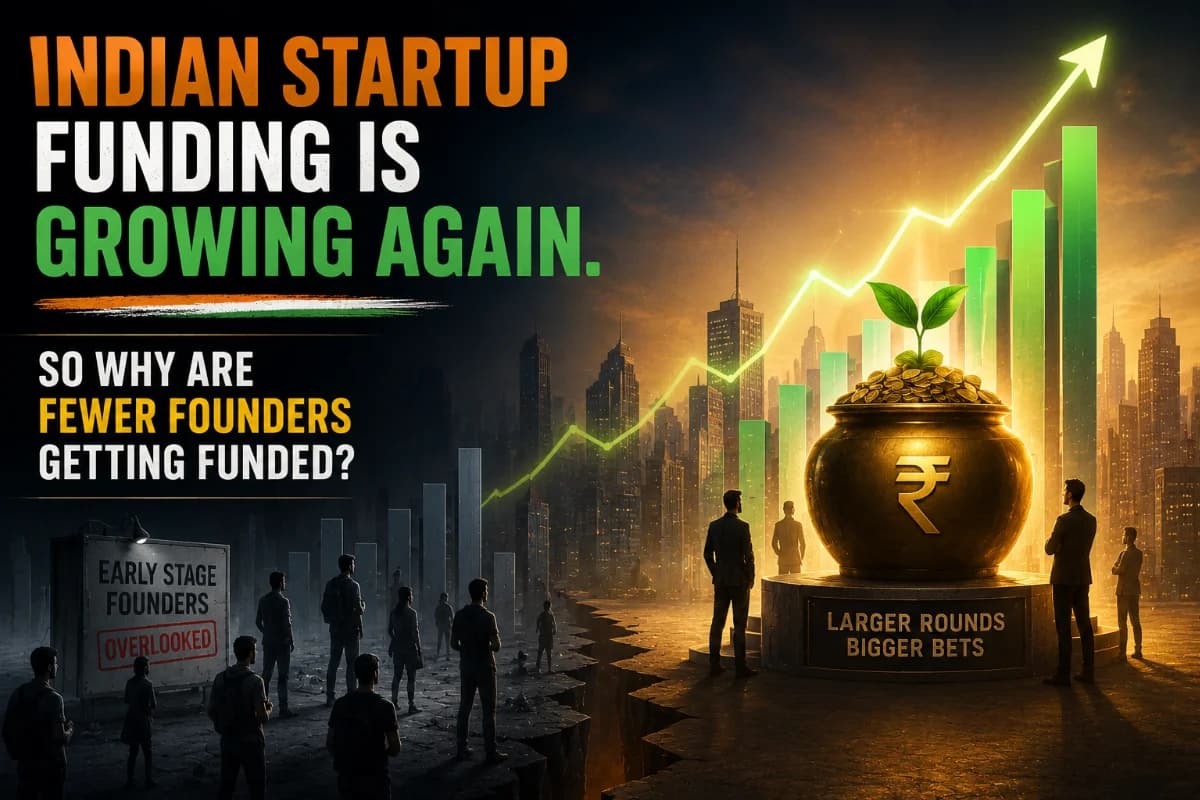
There is a particular kind of optimism that spreadsheets produce. Look at India's startup funding headlines from the past year and you will find plenty of reasons to feel good: nearly $11 billion raised in 2025, a third-place global ranking behind only the United States and the United Kingdom, 94 unicorns and counting, and a government now actively co-investing in quantum computing. The ecosystem, if you go by the aggregate numbers, has never looked more credible.
And yet, if you are a first-time founder trying to raise a seed round right now, those headlines might as well be from a different country.
Because beneath the macro optimism lies a paradox that is reshaping Indian entrepreneurship in ways that nobody is talking about loudly enough: the money is back, but the access is not. Capital is concentrating. Deal counts are collapsing. And the informal filters that once gave scrappy, idea-stage founders a shot at the table are quietly disappearing, replaced by a new, unspoken checklist that most aspiring entrepreneurs don't even know exists.
The numbers look great on the surface. Dig deeper, and a more complicated — and quietly brutal — story emerges.
The Numbers That The Press Releases Don't Mention
Start with the headline that everyone celebrated: Indian tech startups raised approximately $11 billion in 2025. Impressive. Resilient. The kind of number that gets quoted at startup summits and in government speeches about Digital India.
Now look at what happened to the number of deals. According to Tracxn data, funding rounds fell by nearly 39% year-over-year, to just 1,518 deals in all of 2025. In 2026, the trend has only deepened - through June, India has seen 877 equity funding rounds compared to 1,480 in the same period of 2025. That is a 40% drop in deal volume even as the rupee amounts stay relatively stable.
This is not a rounding error. This is a structural shift.
What it means, in plain language, is that roughly the same amount of money is being handed to a dramatically smaller group of people. The average check is getting bigger. The average founder's odds of getting one are getting smaller. And seed funding, historically the category that democratises access to capital, the rung on the ladder closest to the ground which has taken the worst beating of all, falling 44% year-over-year in the first half of 2025 alone.
The ecosystem did not shrink. It narrowed.
The Barbell Nobody Asked For
To understand where the money actually went, picture a barbell. On one end: very early-stage startups with founders who could demonstrate product-market fit, revenue traction, and defensible unit economics within months of launch. On the other end: late-stage companies already proven at scale, capable of absorbing $100 million-plus rounds without flinching. Everything in the mushy middle- pre-revenue, idea-stage, pre-product-market fit which largely got left out.
This barbell dynamic explains something that initially looks contradictory: early-stage funding (Series A and early growth) actually rose 7% year-over-year even as seed funding collapsed. Investors were not avoiding early bets entirely. They were raising the bar for what counted as "early."
A few years ago, a compelling deck and a credible team could open doors at the seed stage. Today, investors want to see a minimum viable product that has already found paying customers. They want to see a founder who understands their CAC and LTV not just as acronyms but as a lived, operating reality. As Neha Singh, co-founder of Tracxn, put it, investors are now backing founders who can "demonstrate stronger product-market fit, revenue visibility, and unit economics in a tighter funding environment."
The bar, in other words, has been relocated from seed stage to Series A. And the seed stage has become, effectively, what used to be Series A.
The Geography of Getting Funded
Here is another dimension of the paradox that rarely makes the headline: where you build matters more than ever.
Bengaluru alone accounted for 26% of all Indian startup funding in the first half of 2025, pulling in $2.5 billion across 143 deals. Delhi-NCR and Mumbai together claimed most of the rest. The historical dominance of these three cities has not just continued, it has intensified.
There is some evidence that investor attention has begun flickering toward Tier 2 cities: more startup events, more mentorship seminars in places like Pune, Ahmedabad, Hyderabad, and Jaipur. But curiosity is not capital. The funding data does not yet support the narrative that India's startup opportunity is becoming geographically distributed in any meaningful way.
For a founder building in Indore or Coimbatore or Patna, the de facto requirement is not just a great idea — it is a relocation plan.
What Investors Are Actually Saying (and Not Saying)
Read enough VC reports from 2025 and a particular vocabulary emerges: revenue visibility, unit economics, governance quality, capital discipline, sustainable growth. EY India's Venture Capital and Private Equity Report for 2025 captures this shift clearly, noting a "decisive shift in investor behaviour toward revenue visibility, governance quality and unit economics, resulting in fewer but more selective investments."
Translated into plain speech: the era of funding the narrative is over. Investors are funding the proof.
This is not inherently wrong. The 2021–22 funding frenzy produced some genuinely terrible companies that are loss-making businesses dressed up in the language of disruption, burning cash at a rate that was never going to resolve into profit. A correction was necessary and arguably healthy.
But corrections have collateral damage. And the collateral damage here is the founder class that doesn't yet have proof - not because they lack ability, but because they lack time, network, and runway. The investors who once provided runway as a vote of confidence have pulled that function from the market. They want to see flight before they fund the aircraft.
The catch-22 is elegant and maddening: you need funding to get traction, and you need traction to get funding.
The Sector That Got Everything (and the Rest That Got Almost Nothing)
The sector-level picture makes the concentration even starker.
Enterprise applications captured roughly 25% of all funding. Retail and consumer commerce took another 23%. Fintech drew $2.2 billion. These three categories like Enterprise, Retail, Fintech, all have functioned as the load-bearing walls of Indian startup capital for years, and 2025 simply reinforced their dominance.
AI, despite being the buzzword of the decade, raised just $643 million in India across 100 deals - a 4% increase from the prior year. Contrast this with the United States, where AI funding surged past $121 billion in 2025, a 141% jump, and you get a sense of how differently the global AI wave has landed on Indian shores. Indian investors have largely preferred AI as a feature layered on top of proven business models rather than as a standalone bet on foundation models or frontier research. The preference is for application over ambition.
Agritech, often celebrated as India's great untapped opportunity, drew record investor interest, with over $1 billion raised in early 2025 and a 35% year-over-year increase in deal activity. Climate tech showed early signs of momentum. Deep tech, nudged by government co-investment and a $2 billion commitment from a consortium including Accel, Blume Ventures, and Celesta Capital with Nvidia joining as adviser, is beginning to find institutional support it never had before.
But these are early signals, not established patterns. If you are building in a sector outside the favoured three, you are fundraising in a much harder environment than the macro numbers suggest.
The Reverse Flip and the Domestic Capital Rise
One underreported story within this funding evolution is the growing role of domestic capital — and the legitimacy it signals about India's ecosystem maturation.
Indian domestic venture funds now account for nearly 45% of all startup funding, up from 28% in 2020. Firms like Blume Ventures, Kalaari Capital, and Chiratae Ventures are leading rounds independently, no longer waiting for foreign validation before writing a check. Indian family offices and corporate venture arms are entering the innovation ecosystem as active participants.
Alongside this, a quiet but meaningful regulatory trend has emerged: reverse flipping. Indian-founded companies that had incorporated abroad — typically in Singapore or Delaware to access foreign capital — are increasingly restructuring to move their parent entity back to India. SEBI's amendments to angel fund regulations, including reduced minimum investment thresholds and a mandate for accredited investors, are making domestic early-stage funding more structured and accessible.
The government has also finally shown up in ways it historically avoided: co-leading a $32 million funding round for quantum startup QpiAI, anchoring a deep tech commitment alongside global VCs, and recognising over 159,000 startups under its Startup India initiative. Regulatory uncertainty — long cited as the single biggest deterrent to long-cycle investment — is starting to abate.
This domestication of capital is genuinely positive. It means India's startup funding is becoming less hostage to global risk-off cycles and foreign LP sentiment. But it also means that access now depends increasingly on being plugged into domestic networks — and those networks still run heavily through metro cities, elite college alumni groups, and established founder-to-investor pipelines.
The Survivors and What They Know
Something worth acknowledging: the founders who are getting funded in this environment are, by most measures, building better companies. The shift away from "growth at all costs" to operational sustainability has produced a cohort of startups with stronger fundamentals than those born in the peak frenzy of 2021.
Startup launches have dropped dramatically — from roughly 9,600 annually during 2019–22 to just 5,264 in 2024. That is not just a funding contraction; it is a winnowing. The founders who persist in this environment tend to be more capital-efficient, more focused on genuine customer problems, and more realistic about timelines to profitability.
The ecosystem is maturing. That much is true.
But maturation and democratisation are different things, and it is worth being honest about which one is actually happening.
The Founder Who Doesn't Fit the New Map
Here is the founder who is falling through the cracks of the new Indian startup landscape: she is not from IIT or IIM. She is building in a Tier 2 city. She is working on an idea that doesn't fit neatly into Enterprise, Retail, or Fintech. She hasn't shipped a product yet because she doesn't have capital, and she can't raise capital because she hasn't shipped a product. She doesn't have alumni networks that lead to warm introductions. She doesn't have a prior exit to point to. She is exactly the kind of founder who, in the 2015–2020 era, might have received an angel cheque from someone willing to bet on the person, not just the proof.
That bet is harder to find today.
This is not unique to India. Global venture capital is consolidating everywhere, moving capital toward the already-proven and already-connected. But India had positioned itself — and still positions itself publicly — as a democratising force, a place where a mobile phone and a billion-person market could unlock opportunity for founders from every corner of society.
The aspiration is right. The current mechanics are not aligned with it.
What Comes Next
There are reasons for measured optimism and not the spreadsheet kind, but the structural kind.
The exit market is improving. More predictable IPO pathways and an uptick in M&A activity are freeing up capital for redeployment. Domestic fund formation is accelerating. Government co-investment in deep tech is beginning to crowd in private capital. SEBI's reformed angel fund framework, if executed well, could genuinely lower the barriers to early-stage funding for founders outside the metro elite.
And the quality bar, while brutal for individual founders in the short term, is producing an ecosystem that global investors are beginning to take more seriously — not as a substitute for the U.S. market, but as a genuinely distinct opportunity with its own logic, its own scalable models, and its own risk profile.
The challenge now is to ensure that the ecosystem's maturation doesn't become its ossification. That the bar rises without the door closing. That the new discipline around unit economics and revenue visibility doesn't become a proxy for only funding founders who already have the luxury of time and resources to achieve them.
India's startup story is not over. But who gets to be the protagonist of that story - that is the question that the $11 billion headline doesn't answer.
And it's the question every founder, investor, and policymaker should be sitting with right now.
Enjoying this story? Sign in to react and follow founders in your feed.