
Story · 10 min read · 1 July 2026
Hyderabad Space Ambition Is No Longer a Dream - It's a Launch Pad in 2026

How India's "City of Pearls" Is Quietly Becoming the Nation's Private Space Capital
There is a building in Hyderabad's Raidurgam district that, on most days, looks like any other glass-and-steel tower in the city's gleaming tech corridor. But walk inside T-Hub - the world's largest startup incubation centre at 572,000 square feet, and you begin to hear words that sound less like a startup pitch and more like a mission briefing. Liquid oxygen. Orbital insertion. Thrust vector control. Hyperspectral imaging.
Hyderabad, long celebrated as India's pharmaceutical powerhouse and software export hub, has quietly developed a third identity: the country's most ambitious private space city. And it is doing so with startups, not just scientists.
The Numbers Telling the Story
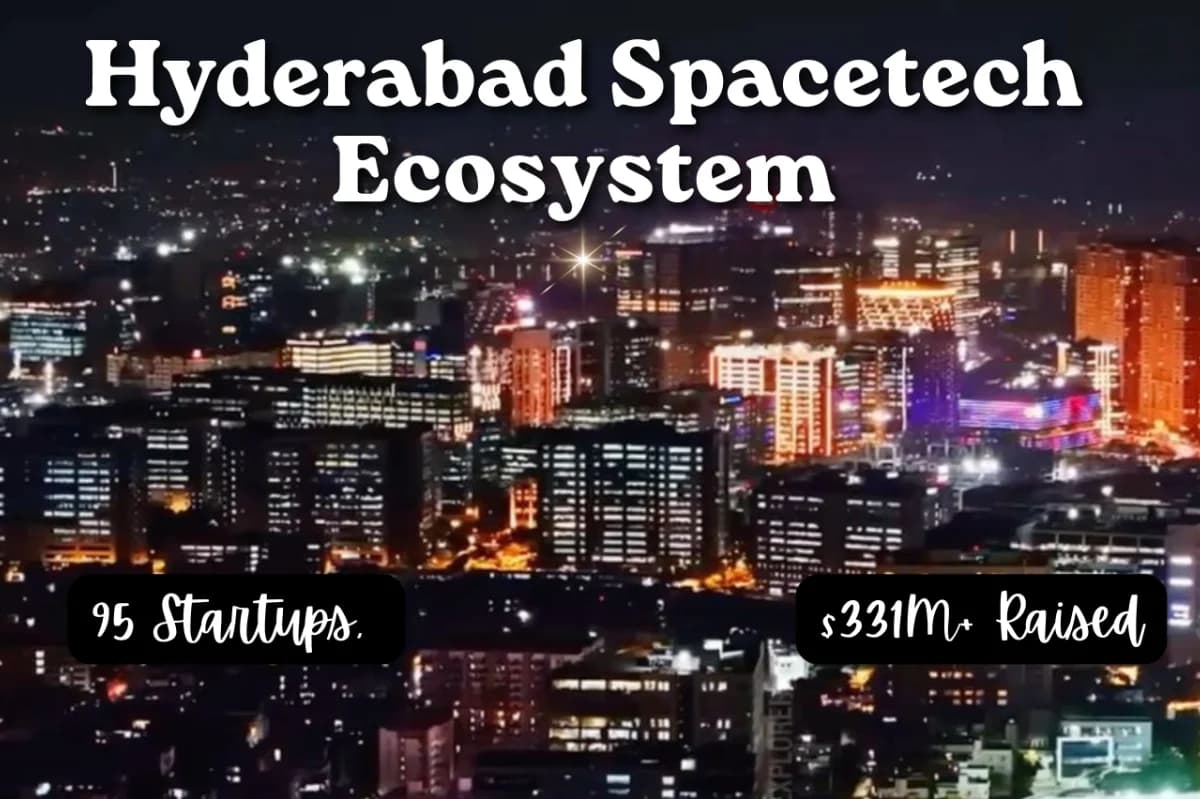
India now has over 300 spacetech startups, the highest concentration in all of Asia. A significant and growing cluster of them around 95, by various ecosystem counts traces its roots, its registrations, or its R&D to Hyderabad and the broader Telangana state. Collectively, these companies have attracted over $331 million in funding, according to industry tracking data, spanning launch vehicles, satellite manufacturing, ground systems, earth observation, and the emerging in-orbit economy.
That number might seem modest against, say, SpaceX's balance sheet. But context matters enormously. Until June 2020, India's private sector was essentially excluded from the space economy. The government's announcement that year - allowing private companies to design, manufacture, and launch rockets and satellites using ISRO's infrastructure triggered what many in the industry now call India's "space spring."
In that compressed five-year window, Hyderabad's startups moved faster than almost anyone expected.
Why Hyderabad? The Infrastructure Answer
The short answer is that Hyderabad had a head start that most cities simply did not.
Long before the policy shift of 2020, the city was already home to a dense concentration of aerospace and defence infrastructure. The National Remote Sensing Centre (NRSC), the National Atmospheric Research Laboratory (NARL), the Defence Electronics Research Laboratory (DLRL), and the Defence Research & Development Laboratory (DRDL) all operate in or near the city. These institutions provided an existing talent base, supply-chain relationships, and testing environments that new startups could tap into from day one.
Telangana's government moved early to formalise this advantage. The state launched its SpaceTech Framework to position Hyderabad as a commercial hub for space-related products and services, covering launch vehicles, satellite systems, subsystems, and ground equipment manufacturing. It was, notably, the first major state-level space policy in India - launched in a space-themed metaverse environment that captured the ambition, if not the subtlety, of the moment.
Hyderabad's SMEs had already demonstrated their capabilities long before this policy era. They contributed over 30 percent of the parts used in ISRO's Mars Orbiter Mission, a fact that Telangana's government officials regularly cite, with justifiable pride, as proof that the city's industrial base is space-ready at scale.
The Telangana Academy for Skill and Knowledge (TASK) added to this by creating specialised training programmes in space technologies, feeding a pipeline of engineers and technicians into the growing sector. Institutions like IIT Hyderabad and the University of Hyderabad formalised partnerships with space companies, turning academic research into startup-ready intellectual property.
T-Hub and the Incubation Flywheel
At the centre of the ecosystem's startup formation engine sits T-Hub, which has supported over 2,000 startups since its founding and helped them collectively raise over $2 billion. Its Atal Incubation Centre (AIC) launched the Orbit programme — described as one of India's first dedicated SpaceTech incubation efforts — specifically to accelerate startups from early MVP stage through to commercial launch.
The programme offers product development resources, mentorship from industry veterans and researchers, and critically, direct access to ISRO's infrastructure under India's liberalised space framework. T-Hub also co-hosted the InveSt Space Hyderabad Edition alongside IN-SPACe in early 2026, convening over 110 ecosystem leaders — founders, VCs, angel investors, policymakers, and international delegates — in a single room. Thirty-plus startups pitched across the full value chain, from launch systems to the in-orbit economy.
The event reinforced something that data had already suggested: 11 of the participating spacetech companies were headquartered in Hyderabad itself, with the rest drawn from across India to present to a Hyderabad investor audience. The city is not just producing startups. It is becoming the capital where space deals get done.
The Startups Carrying the Weight
Skyroot Aerospace: India's First Space Unicorn
No story of Hyderabad's space moment is complete without Skyroot Aerospace — and in May 2026, Skyroot stopped being merely a Hyderabad story and became a national milestone.
The company, founded in 2018 by former ISRO scientists Pawan Kumar Chandana and Naga Bharath Daka, raised $60 million in a fresh round co-led by Singapore's sovereign wealth fund GIC and Sherpalo Ventures, with participation from BlackRock, the founders of Greenko Group, Arkam Ventures, Playbook Partners, and Shanghvi Family Office. The round pushed Skyroot's valuation to $1.1 billion — making it India's first spacetech unicorn, and the first Indian private space startup to cross the threshold.
Total funding now stands at approximately $160 million since the company's founding. The capital will fund increased launch frequency for Vikram-1 (India's first privately developed orbital rocket, preparing for launch), expansion of manufacturing capacity, and development of the next-generation Vikram-2, which will use a cryogenic upper-stage engine.
Skyroot's journey is a compressed history of what India's space liberalisation made possible. It was incubated at T-Hub. It became the first private Indian company to sign a formal agreement with ISRO for testing and launch support. In November 2022, it launched Vikram-S — India's first privately built rocket to reach space — from Sriharikota. By August 2025, it had successfully static-fired the Kalam-1200, the first-stage solid motor for Vikram-1. In February 2026, its Dhawan-III cryogenic engine completed a 145-second endurance test. In January 2025, the Telangana government signed an MoU with Skyroot at the World Economic Forum to establish a dedicated rocket manufacturing, integration, and testing facility in the state with an investment of ₹500 crore.
Prime Minister Narendra Modi personally inaugurated Skyroot's Infinity Campus — a modular production facility designed to roll out one orbital rocket per month. That is not a figure many space startups anywhere in the world can claim.
In June 2025, Skyroot and Axiom Space signed an MoU to explore integrated orbital and launch systems for missions to the Axiom Station and beyond. Silicon Valley legend Ram Shriram — an early Google backer and Sherpalo Ventures founder — is expected to join Skyroot's board.
Dhruva Space: The Connective Tissue
If Skyroot is Hyderabad's flagship rocket startup, Dhruva Space is the city's quiet infrastructure builder. Founded in 2012 by Sanjay Nekkanti and co-founders, the company provides end-to-end space engineering solutions: satellite platforms, orbital transfer vehicles, launch solutions, and ground station services as a managed offering.
Dhruva Space has raised $21.66 million across multiple rounds, with backers including Blue Ashva Capital, the Indian Angel Network, GVFL, and the Technology Development Board. In November 2025, it raised ₹51.76 crore, followed by a proposed raise of ₹38.7 crore from IAN Alpha Fund, GVFL, Blue Ashva Capital, and Pradeep Sinha.
In February 2026, IN-SPACe selected Dhruva Space — alongside Astrome Technologies and Azista Industries — to develop indigenous small satellite bus platforms under a dedicated scheme, receiving a ₹5 crore grant to build modular and scalable satellite bus systems capable of supporting high-volume manufacturing of 500–600 satellites annually. It subsequently received ₹105 crore under the Department of Science & Technology's Research and Development Intensive (RDI) Fund, launched in July 2025.
The RDI scheme targets deep tech, AI, robotics, space, biotech, and climate tech — and Dhruva Space's selection signals recognition that the company's infrastructure-layer work is as strategically critical as launch capability.
The Broader Hyderabad Constellation
Beyond Skyroot and Dhruva, a wide field of companies is building out Hyderabad's space value chain:
Azista-BST is developing full-stack satellite manufacturing capabilities for small satellites, working alongside Dhruva Space in the IN-SPACe satellite bus programme.
Ananth Technologies Ltd (ATL), founded nearly three decades ago by Dr. Subba Rao Pavuluri — widely regarded as the grandfather of India's spacetech startup ecosystem — provides space hardware manufacturing and has been a quiet anchor in the city's aerospace supply chain for decades. Pavuluri's long-view perspective on India's space ambitions carries weight: he has called for space to be classified as critical infrastructure to ease access to financing.
SpanTrik has completed a successful test flight of its vertical take-off and vertical landing (VTVL) demonstrator "Hopstone" — a significant step in India's emerging reusable launch vehicle ecosystem — and is incubated through AIC T-Hub's Orbit programme.
Sanyark Space, Cosmoserve, Red Balloon Aerospace, ADT Core, and Stardour are among the next generation of Hyderabad-based spacetech companies pitching to investors and building out capabilities across the satellite and launch value chain.
EON Space Labs, Avantel, Astra Microwave Products, and several other established and emerging players round out a city-level ecosystem that spans from microwave systems and satellite subsystems to earth observation and in-orbit services.
The Policy Scaffolding
India's national-level policy shift in 2020 — the creation of IN-SPACe as an autonomous regulator under the Department of Space — was the original catalyst. By early 2025, IN-SPACe had authorised over 250 private entities to participate in the space economy and had received over 658 applications covering satellite development and deep space exploration. Over 1,200 startups and 6,400 users were registered on its digital platform.
The government has layered further support since then. The Union Budget 2024–25 announced a dedicated ₹1,000 crore venture capital fund for space startups — a signal of institutional commitment that the sector had been lobbying for. The 2025 budget allocated approximately ₹13,416 crore ($1.57 billion) to the Department of Space overall.
A GST exemption regime for spacetech startups was introduced by the GST Council, reducing the cost burden on early-stage companies. IN-SPACe launched a ₹500 crore Technology Adoption Fund in 2025 to help companies scale promising technologies, funding up to 60 percent of project costs for startups and MSMEs.
Separately, the government established a ₹10,000 crore fund led by IN-SPACe to invest in 40-plus companies over five years, with individual investments ranging from ₹10 crore to ₹60 crore.
For Hyderabad specifically, Telangana's SpaceTech Framework created the state-level architecture: incentives for manufacturing, support for domestic production across the full satellite and launch value chain, and formalised industry-academia linkages.
The Investment Landscape
Hyderabad's space startups have drawn capital from a diverse and increasingly international pool of investors. Singapore's GIC — one of the world's largest sovereign wealth funds — is a repeat Skyroot backer. BlackRock, the world's largest asset manager, joined Skyroot's unicorn round. Sherpalo Ventures, founded by Google early backer Ram Shriram, led the deal.
Domestically, Arkam Ventures, Greenko Group's founders, Shanghvi Family Office, Hyderabad Angels, and the government-backed AIC T-Hub have all been active in the ecosystem.
The broader India spacetech funding picture provides useful context: total sector funding crossed $93.7 million in 2025 alone, and the cumulative figure over the past decade has exceeded $467 million. Hyderabad's startups account for a meaningful and growing share of that capital.
India's space economy, currently valued at $8.4 billion, is projected to reach $44 billion by 2033 — growing its global share from 2 percent to 8–10 percent. The Indian spacetech market is expected to compound at 26 percent annually from 2023 to 2030. Against that trajectory, the capital flowing into Hyderabad's ecosystem looks not like a speculative bet, but like a long-term structural position.
The Challenges Ahead
Honesty requires acknowledging the headwinds alongside the momentum. Total funding raised by Indian spacetech startups fell 35 percent year-on-year in 2024, even as the number of deals rose. The market is maturing, but it is not yet deep.
India's Space Activities Bill — which would grant statutory authority to IN-SPACe and address private-sector concerns around intellectual property rights, insurance access, and liability — has been under redrafting for years. Regulatory uncertainty persists in its absence.
Infrastructure remains uneven across the broader ecosystem. Supply chains for space-grade components are still thin, and the country's launch cadence — despite Skyroot's impending Vikram-1 debut — has not yet reached the frequency that a healthy commercial market requires.
Lt. Gen. (Retd.) Anil Kumar Bhatt, Director General of the Indian Space Association, has consistently argued that the government must remain an anchor customer — mandating geospatial or space data for planning and operations to significantly boost demand-side pull. Without that anchor, private startups face the challenge of simultaneously building technology, proving it commercially, and educating a customer base, all at the same time.
What Hyderabad Represents
The deeper significance of what is happening in Hyderabad is not just economic. It is about the compression of the space between policy intent and on-the-ground execution.
India spent 60 years building space capability inside a single government agency. The private opening of 2020 gave startups five years to prove they could contribute. Hyderabad's founders — many of them former ISRO scientists, IIT graduates, and defence engineers — showed up with deep technical credibility and a city that was ready to host them.
The result is an ecosystem with genuine depth: established players like Ananth Technologies providing supply-chain anchors, growth-stage companies like Skyroot and Dhruva Space demonstrating product-market fit, and early-stage startups incubated at T-Hub building the next wave of capability.
India is, as one observer put it, no longer watching space from below. It is building the rockets, the satellites, and the data layers that will let the world watch Earth from above. And a striking amount of that building is happening in a city better known for biryani, bulk drug manufacturing, and business process outsourcing.
That, perhaps, is the most compelling argument for Hyderabad's space ambitions: the city has always been underestimated, and it has always delivered.
Enjoying this story? Sign in to react and follow founders in your feed.