
Story · 5 min read · 13 July 2026
How to Survive a Crowded Market: Lessons from the upGrad-Unacademy Merger

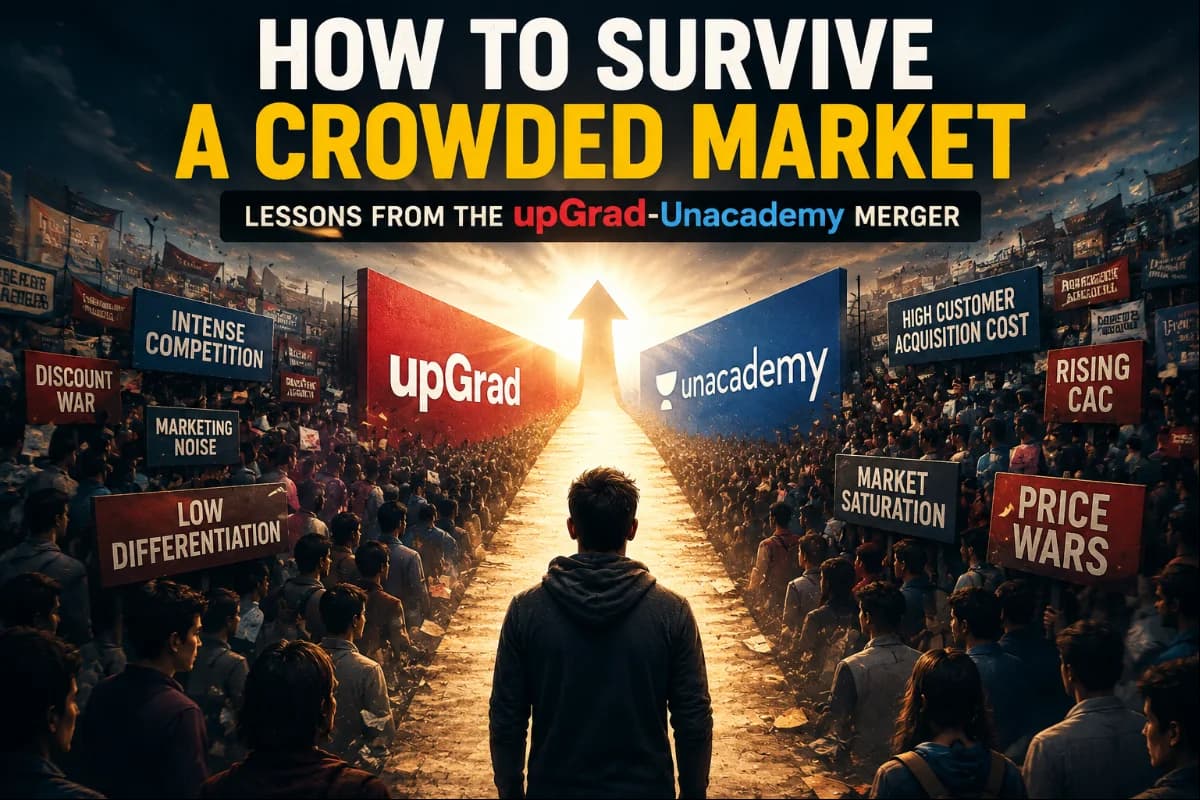
Every founder eventually faces the same uncomfortable realization: the market you built for isn't yours alone anymore. Competitors multiply, funding gets harder to justify, and growth that once felt inevitable starts to slow. The question stops being "how do we win" and becomes something more basic - "how do we survive long enough to matter."
India's edtech sector just answered that question in real time. In March 2026, upGrad signed a term sheet to acquire Unacademy in an all-stock deal. By July, regulators cleared it, with Unacademy valued at roughly ₹2,055 crore -about $218 million, down nearly 90% from its 2021 peak of $3.4 billion.
That number is the headline. But the real story is a survival case study, the one that applies far beyond edtech, to any founder building in a category that's gone from "exciting" to "crowded."
Here's what surviving a crowded market actually looks like, using this deal as the evidence.
Survival Rule 1: Cash Outlasts Charisma
Unacademy had the brand, the user base, the celebrity educators, the pandemic-era hype. None of that is what made it a viable acquisition target in 2026. What mattered was its balance sheet, which is reportedly $100 million or more in cash reserves, which became one of the most attractive parts of the deal for upGrad.
In a crowded market, your brand gets you noticed. Your cash gets you through. Founders who treat fundraising as a growth accelerant instead of a survival buffer are the ones who run out of options exactly when they need them most. The lesson isn't "raise more", it's "spend like the money you have is the only money you'll ever get."
Survival Rule 2: Pick a Lane and Stay In It
Gaurav Munjal, Unacademy's co-founder, was candid about what went wrong: the company lost focus, and the broader sector hadn't produced enough real product innovation in recent years. During Unacademy's toughest stretch, some of that focus reportedly shifted toward a new, unrelated AI language-learning app, a move that created friction with investors who felt the core test-prep business was being left to drift.
This is one of the most common survival mistakes in a crowded category: chasing a new opportunity while your original business is still fighting for oxygen. It looks like adaptability. It's usually distraction. Markets that are crowded punish split attention faster than markets that are still empty, there's no slack left to absorb a half-committed pivot.
If you're going to bet on something new, you either need the resources to run two real businesses at once, or the discipline to finish fixing the first one before starting the second.
Survival Rule 3: Know What You'd Bring to a Combination
Here's what made the upGrad-Unacademy deal work where an earlier attempt to sell Unacademy to Allen Career Institute had failed: the pieces actually fit. upGrad had enterprise reach, university partnerships, and B2B revenue, the boring, durable stuff. Unacademy had consumer brand recognition and a test-prep audience upGrad didn't have.
Surviving a crowded market often isn't about outcompeting everyone in it. It's about knowing which gap you fill for someone else. The founders who only ever ask "who's beating me" miss the more useful question: "who's missing what I have, and who has what I'm missing?" That question is what turns a struggling business into an acquisition target instead of a write-off.
Survival Rule 4: A Lower Valuation Isn't the Same as Losing
It's tempting to read Unacademy's 90% valuation drop as a failure story. It isn't, quite. Munjal continues to lead Unacademy inside the combined entity. This was a negotiated outcome with agreed terms, including an undisclosed break fee if the deal fell through which is not a collapse. Compare that to Byju's, once India's most valuable startup, now in insolvency with its valuation effectively at zero. Or compare it to Physics Wallah, which took a different survival path entirely: turning profitable and going public.
Three companies. Same crowded category. Three different survival outcomes. The lesson: surviving doesn't always mean staying independent, and it doesn't always mean growing. Sometimes it means recognizing which of the three paths which are profitability, acquisition, or collapse that is actually available to you, and choosing the best one early instead of the only one left late.
Survival Rule 5: Move Before the Market Forces Your Hand
Unacademy's road to this deal wasn't straight. It first tried to sell to Allen Career Institute; that fell apart over valuation. upGrad itself reportedly walked away from talks at one point over disagreements on what each side was worth. It took until Unacademy's valuation had already fallen below $500 million - an 85% drop Munjal acknowledged publicly that's for both sides to actually agree on terms.
That timeline is the real warning. The deal that eventually happened at $218 million could have happened earlier, at a better number, if both sides had moved before the market made the decision for them. Founders holding out for a better valuation in a cooling category aren't always being patient, sometimes they're just delaying an outcome that gets worse the longer they wait.
What Surviving Actually Requires

Put together, the upGrad-Unacademy deal outlines a rough survival playbook for any founder in a category that's stopped being empty:
Build your runway assuming the funding environment won't rescue you. Cash reserves, not brand equity, are what make you a viable partner when the market tightens.
Finish what you started before starting something new. A distracted core business is more dangerous in a crowded market than in a new one.
Map your gaps honestly, and look for who fills them. The company that completes you is often more valuable to find than the one you're trying to beat.
Separate "lower valuation" from "failure." A negotiated reset, on your terms, beats a forced write-down on someone else's.
Act on your own timeline, not the market's. Every quarter you wait for a "clean" outcome is a quarter the crowded market gets to decide your options for you.
The Bigger Picture
Edtech isn't unique in going through this. Every category that raised money on a growth story between 2020 and 2022 - fintech, D2C, quick commerce, SaaS etc. are running the same clock. Some companies in those spaces will do what Physics Wallah did and grow into real profitability. Some will do what Byju's did and disappear. And some will do what upGrad and Unacademy just did: recognize that combining is smarter than competing, and negotiate that outcome while there's still something worth negotiating.
Surviving a crowded market was never about being the last one standing alone. It's about still having a seat at the table when the market finally sorts out who gets to keep building, whether that's on your own, or as part of something bigger.
Enjoying this story? Sign in to react and follow founders in your feed.