
Story · 6 min read · 1 July 2026
Tier-2’s Hidden Tax: The Cost of Building a Startup Outside Metro Cities

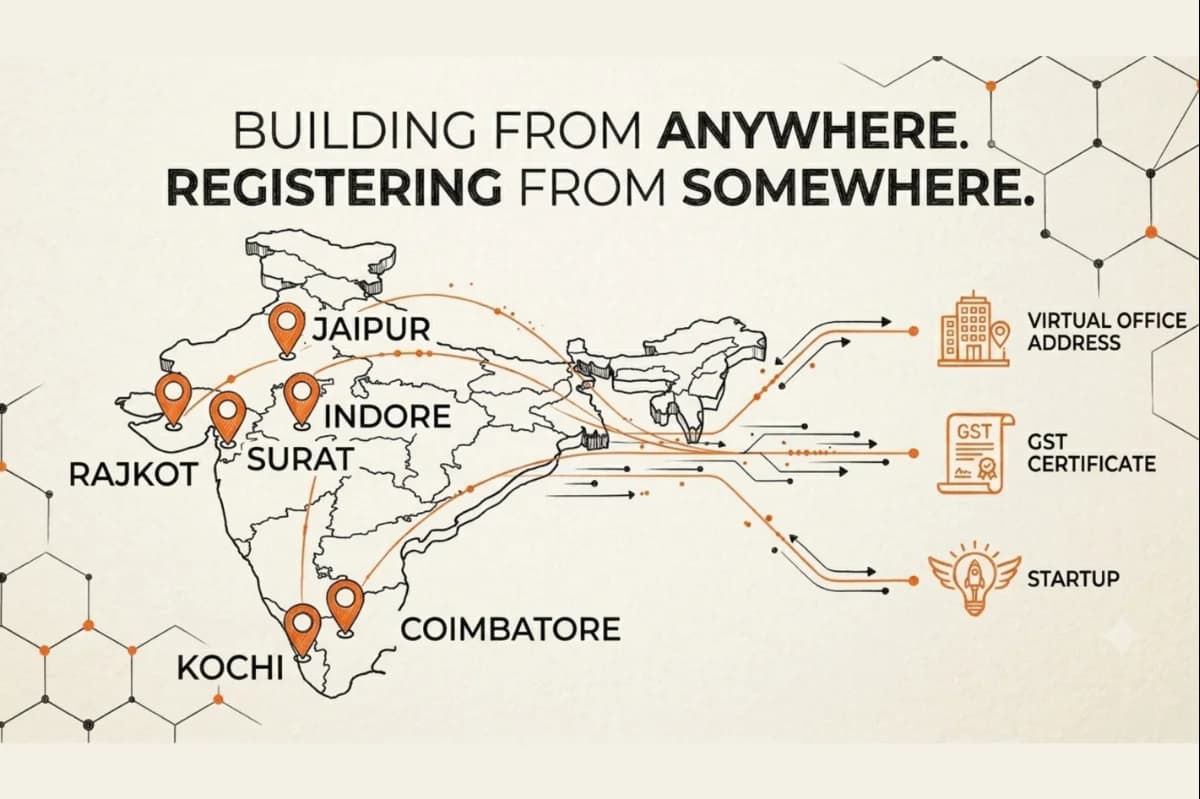
The Indian Startup Story Has Moved Beyond Bengaluru. The Paperwork Hasn't.
Welcome to the real entrepreneurial world in India.
For years, the default image of an Indian startup founder was predictable: a laptop in a Bengaluru co-working space, a pitch deck, and a coffee meeting in Koramangala.
That image is becoming outdated.
The next wave of Indian entrepreneurship is coming from places like Surat, Rajkot, Indore, Jaipur, Coimbatore, Nagpur, Bhubaneswar, and hundreds of other Tier-2 and Tier-3 cities.
Recent industry analysis suggests that around 48–51% of DPIIT-recognised startups are now based outside India's major metros [STAT: DPIIT/industry analysis source needed]. The founder geography has changed dramatically.
The infrastructure around them, however, is still catching up.
A founder in Surat can hire developers remotely, sell software globally, receive international payments, and build a profitable company from a home office. But when it comes to basic administrative requirements like GST registration, company incorporation documentation, or maintaining an official business address, the process often becomes surprisingly complicated.
This is the hidden tax of building outside India's startup capitals: not less ambition, but more operational friction.
Why Is GST and MCA Registration Still a Challenge for Tier-2 Startup Founders?
The biggest challenge isn't building the product. Sometimes, it's proving your business exists on paper.
A startup needs a legitimate registered address for various compliance purposes, including company incorporation, GST registration requirements, and official communication. For many early-stage founders, especially bootstrapped entrepreneurs, renting a dedicated office in their city makes little financial sense.
Imagine a solo SaaS founder in Rajkot. The team works remotely. Customers are overseas. Meetings happen on Zoom. The business may not require a physical office for operations. But compliance frameworks still require an address backed by valid documentation.
This creates an awkward gap: the modern startup operates digitally, while many compliance systems still expect a traditional physical footprint.
That gap is exactly where compliance-grade virtual office providers have entered the market.
What Is a Compliance-Grade Virtual Office?
A compliance-grade virtual office is a service that provides businesses with a legitimate commercial address along with the documentation required for regulatory purposes such as GST registration and company registration, depending on eligibility and applicable rules.
The phrase "virtual office" can be misleading.
Many founders imagine it as simply paying for a fancy address in Mumbai or Bengaluru to impress clients. That is only a small part of the story.
A serious virtual office service generally includes:
A commercial business address
Rent agreement or lease documentation
No Objection Certificate (NOC) from the property owner
Address proof documents required during registration processes
Mail handling and communication support
The difference matters.
A cheap "address-for-hire" service may create future compliance headaches. A compliance-focused provider is designed around the documentation standards government processes typically require.
For founders, the question is no longer, "Do I need an office?"
The better question is, "Do I have a legally acceptable business address?"
Are Virtual Offices Legal for GST Registration in India?
Yes, virtual offices can be used for GST registration in India if they satisfy the applicable GST requirements and provide valid documentation.
However, founders should understand that using a virtual office does not remove compliance responsibilities.
Authorities may verify business addresses, request supporting documents, or conduct physical verification depending on the circumstances. Choosing a provider only because it is cheap can become an expensive mistake.
A founder should evaluate:
Whether the provider offers complete GST documentation
Whether the property has a legitimate commercial use arrangement
Whether agreements are legally executed
Whether the provider has experience handling GST and MCA requirements
The goal is not just getting the GST number approved. The goal is maintaining compliance after registration.
The Rise of Virtual Offices Reveals a Bigger Problem in India's Startup Ecosystem
The growth of virtual office GST registration services tells a larger story.
India has successfully democratized entrepreneurship. A founder no longer needs to move to Bengaluru, Mumbai, or Delhi to access customers, talent, or technology. What remains centralized is much of the business infrastructure surrounding entrepreneurship.
A founder in Ahmedabad or Surat should not have to choose between paying unnecessary office rent and struggling through address documentation hurdles. Virtual offices are essentially a market solution to a structural gap: modern businesses have become location-independent faster than administrative systems have evolved.
And this trend will likely accelerate as more startups emerge from smaller cities.
How Should Tier-2 Founders Choose a Virtual Office Provider?
The best virtual office provider is not necessarily the one with the most premium location or the lowest monthly price.
A founder should think like an operator.
Ask practical questions:
Will this documentation work for GST registration?
Is the provider experienced with startup incorporation?
What happens if tax authorities require verification?
Is there customer support for compliance-related queries?
Are there additional hidden charges?
Saving a few thousand rupees at the beginning is not worth risking future regulatory complications.
For an early-stage startup, reliability matters more than a prestigious pin code.
The Real Startup Infrastructure Gap Is No Longer Internet. It Is Compliance.
A decade ago, the biggest disadvantage of building outside metros was access.
Access to investors. Access to talent. Access to technology.
Today, much of that gap has narrowed.
A founder in Surat can raise funding online, hire a developer from another state, and sell a product globally. The newer challenge is far less glamorous: paperwork, registrations, compliance documentation, and operational processes built around older assumptions of how businesses function.
Virtual offices are not merely a convenience. Their growing demand is evidence of a deeper transformation happening in India's startup ecosystem. The next million founders may not come from Koramangala or Gurugram. They may come from Rajkot, Nashik, Kochi, or Jodhpur.
The startup ecosystem now has to catch up with them.
Key Takeaways
Nearly half of India's recognised startups now emerge from Tier-2 and Tier-3 regions [STAT: DPIIT/industry analysis source needed].
Virtual offices are increasingly solving GST and MCA registration challenges for remote-first founders.
A compliance-grade virtual office is very different from simply renting a mailing address.
Founders should prioritise legal documentation, verification readiness, and provider reliability over low prices.
The trend highlights a broader shift: India's entrepreneurship has decentralised faster than its business infrastructure.
Frequently Asked Questions
1) Can a startup use a virtual office for GST registration?
Yes, a startup can use a virtual office for GST registration if the address and supporting documents satisfy GST requirements.
2) Is a virtual office the same as a fake business address?
No. A legitimate virtual office provides legally valid documentation and services. A fake or unsupported address can create serious compliance risks.
3) Why are Tier-2 founders choosing virtual offices?
Many early-stage founders operate remotely and do not need a full physical office but still require a registered address for compliance.
4) Does having a Bengaluru or Mumbai address help a startup raise funding?
An address alone does not determine startup quality. Today, investors increasingly evaluate traction, market opportunity, and execution rather than location.
5) What documents are typically provided with a virtual office?
Depending on the provider, this may include rent agreements, NOCs, utility proofs, and other documents required for registration processes.
6) Should bootstrapped founders rent a physical office instead?
Not necessarily. If a startup operates remotely, a compliance-grade virtual office may be a more cost-efficient option.
Enjoying this story? Sign in to react and follow founders in your feed.