
Story · 5 min read · 14 July 2026
India's AI Talent War: Why Startups Are Hiring AI Engineers Before Product Managers

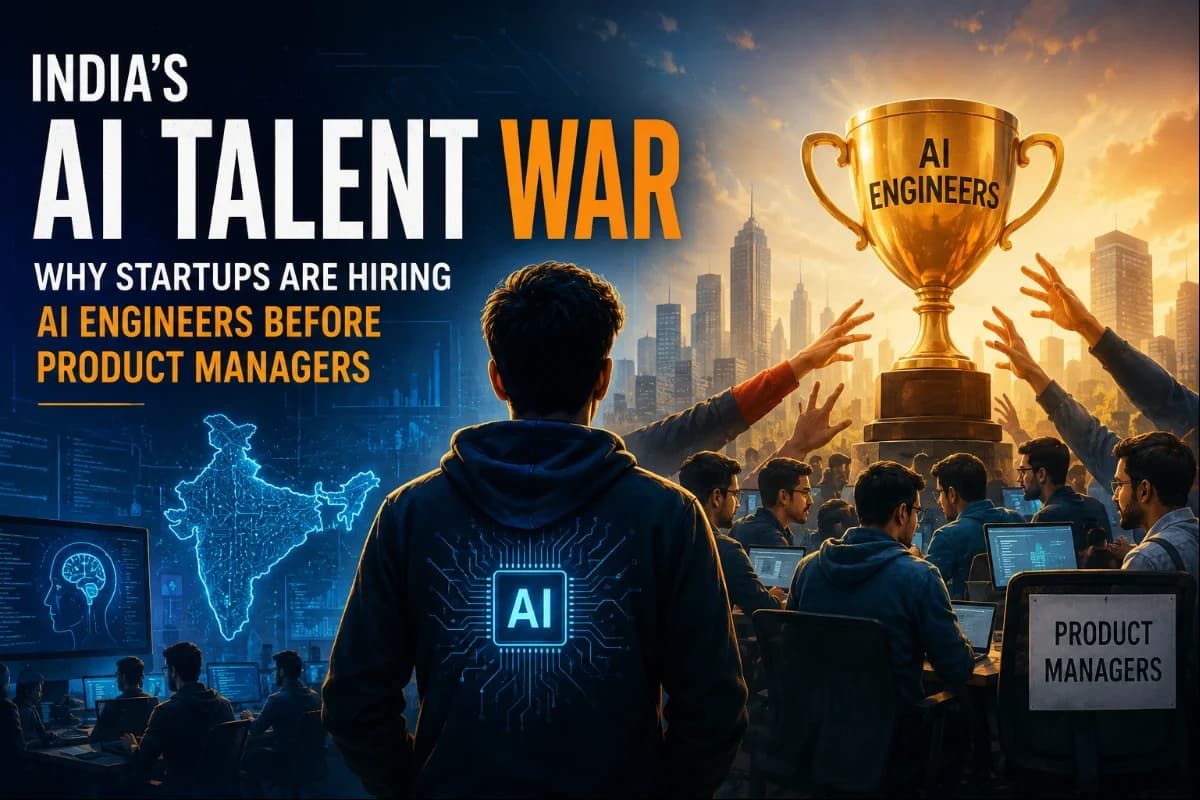
There's a new sentence founders are saying in board meetings across Bengaluru, Gurugram, and Hyderabad: "We'll figure out the PM later, get me the AI engineer first."
Six months ago, that sentence would have sounded backwards. Product managers used to be hire #3 or #4 at any startup - the person who translates chaos into a roadmap once the founders have proven something works. Today, they're being pushed down the list. In their place: AI engineers, ML infrastructure leads, and anyone who can say "RAG pipeline" and mean it.
This isn't a hiring fad. It's a structural shift in how Indian startups build, and it's happening because the market has quietly made AI engineering the scarcest, most expensive, and most existential hire a founder can make.
The Numbers Behind the Panic
The maths is brutal, and every founder doing hiring right now already feels it.
Demand for AI engineers in India is rising roughly 40% year-on-year, while the skilled talent pool is growing at only 15–20%. That gap which was far more open roles than people qualified to fill them, now is the single biggest force behind what's happening in hiring rooms right now. Around 11.7% of all job postings in India now explicitly require AI skills, up from 8.2% just a year ago.
The pricing reflects the panic. AI-native startups and product companies are paying 40–70% more than traditional IT services firms for equivalent experience. A mid-level AI engineer at a Bengaluru product company can pull ₹30–55L in base salary against a comparable Software Engineer's ₹20–35L - a 20–40% premium baked in as standard, not exceptional. GenAI and MLOps specialists add another 20–40% on top of that. At frontier-model teams like Sarvam AI and Krutrim, freshers are opening at ₹20–40L, with mid-level engineers clearing ₹40–75L that offers that would have been reserved for 8-year veterans three years ago.
Compare that to the traditional early hire, the product manager. There's no equivalent scarcity premium. No bidding war. No founder losing sleep over a competitor poaching their PM candidate with a signing bonus and a GPU budget.
Why AI Engineers Jumped the Queue
For most of the last decade, the standard early-startup hiring order looked like:
founder(s) → first engineer → product manager → growth/marketing → more engineers
The PM's job was to make sure the thing being built actually mattered to users.
Three things broke that order.
1. The product now has to be built with AI at the core, not bolted on. A startup that ships a chatbot wrapper today is already behind. Building a genuinely useful AI feature which one with real evals, low hallucination rates, and inference costs that don't torch the runway that needs someone who understands model behavior, retrieval architecture, and token-cost engineering from day one. That's not a plug-in skill a generalist engineer picks up over a weekend; it's a specialization, and specializations that are scarce get hired first.
2. Technical founders can act as their own first PM, they can't act as their own AI engineer. Most technical founders in India can write a product spec, run user interviews, and prioritize a backlog well enough to survive the first 12 months without a dedicated PM. Very few of them can also fine-tune an LLM, build a production RAG pipeline, or bring per-query inference costs down 40% without quality regression. The founder can defer the PM hire. They cannot defer the AI hire.
3. Investors are asking a different first question. Where a pitch used to open with "who's your PM and what's the roadmap," it now opens with "who's building your AI stack, and is it defensible." Series A and seed investors increasingly treat the AI engineering hire as proof the founder is serious about the product's core technology that not a role to backfill after traction.
What This Looks Like Inside Real Startups
The pattern shows up consistently in how Indian startups are structuring their early teams in 2026:
Fintech and healthtech startups are hiring an AI/ML engineer as employee #2 or #3, ahead of any dedicated product or growth hire, specifically to build fraud-detection or diagnostic models that are the actual product.
Consumer-AI and Indic-language startups are competing directly with Sarvam AI, Krutrim, and AI4Bharat for engineers who've fine-tuned Indic models like a genuinely rare skill set, since standard tokenizers are inefficient on Hindi, Tamil, and Telugu text, and only a handful of engineers in the country have shipped production fixes for it.
B2B SaaS startups are converting former backend engineers into "AI engineers" internally rather than waiting to hire externally, because the external market has priced the role out of reach for a seed-stage budget.
GCCs and larger product companies like Microsoft India, Google India, and a wave of well-funded startups which are absorbing junior AI talent at ₹25–50L straight out of college, drying up the fresher pool that startups would normally have relied on.
The result: startups aren't just hiring AI engineers first. Many are restructuring the entire early headcount plan around one core question, do we have someone who can actually ship the AI feature that is the product which before they ask any question about who manages that product.
Where This Leaves Product Managers
This doesn't mean product management is becoming irrelevant in Indian startups, it means the sequencing has changed, not the destination. PMs are still getting hired, just later, and increasingly with a different mandate: PMs who can read model evals, understand latency trade-offs, and speak the language of AI engineers are landing offers faster than generalist PMs with a pure growth or B2B SaaS background.
The founders who are getting this right aren't skipping product thinking. They're doing it themselves, or splitting it across the founding team, until the product has enough AI-native substance to justify a dedicated PM. The ones who wait too long to hire the AI engineer are discovering, the hard way, that a great product roadmap for a mediocre AI backend still ships a mediocre product.
The Real Takeaway for Founders
India's AI talent war isn't a temporary spike like it's the market pricing in a permanent shift in what "building a product" means when AI is the product, not a feature. If a startup's core value depends on model performance, retrieval quality, or inference cost, the AI engineer isn't a support hire. They're the product team.
Founders who are still hiring in the old order, PM first, AI engineer once there's traction that are increasingly finding themselves out-bid, out-built, and out-shipped by founders who flipped the sequence six months ago.
The war for AI talent in India isn't coming. It's already being fought, one offer letter at a time.
Enjoying this story? Sign in to react and follow founders in your feed.