
Story · 6 min read · 1 July 2026
How India's Digital Public Infrastructure Is Becoming Every Startup's Competitive Advantage

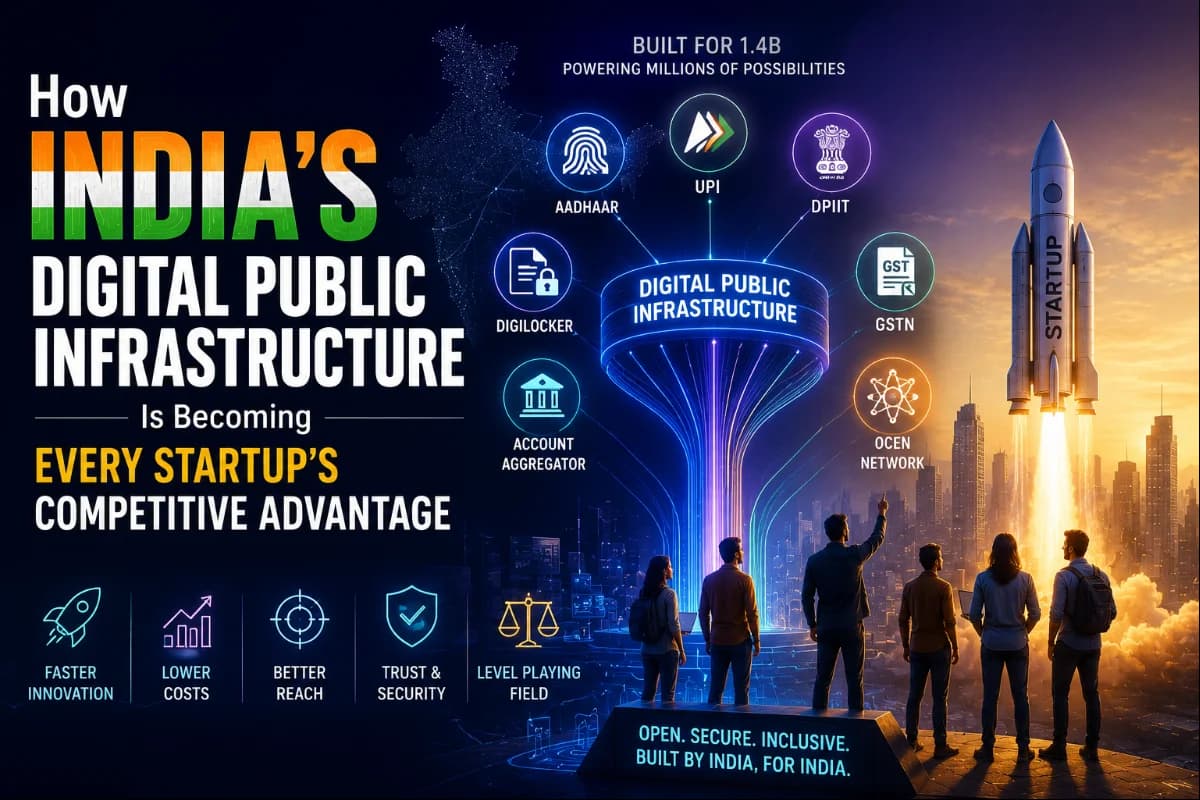
There is a question that every founder building in India should be asking, and most are not asking loudly enough: what does it actually cost to build a startup in a country where the government has already solved identity, payments, data portability, and commerce discovery — and made all of it open?
The answer, increasingly, is: a lot less than anywhere else on earth. And the gap is widening every year.
India's Digital Public Infrastructure - the constellation of open, interoperable systems known collectively as the India Stack that has crossed a threshold in 2026 that makes it impossible to treat as merely a governance story. It has become a founder story. The platforms that were once described as tools for financial inclusion or e-governance efficiency have quietly become the most powerful, most democratically accessible startup infrastructure on the planet. The founders who understand this first are building faster, spending less, and reaching more customers than their competitors who are still paying to solve problems that India's government solved years ago.
Silicon Valley builds with venture capital. India builds with something far more durable: public infrastructure that anyone can plug into.
What Exactly Is Digital Public Infrastructure?
DPI refers to a set of foundational, interoperable digital systems built at population scale, usually backed or enabled by the government, that any business can plug into. In India, the three pillars are widely known as the JAM Trinity plus stack:
Aadhaar: a unique digital identity for over a billion residents, enabling instant, low cost identity verification
UPI (Unified Payments Interface): a real time payments rail that has made digital transactions nearly free and instant
DigiLocker and Account Aggregator framework: systems for secure document sharing and consented financial data access
Add to this ONDC (Open Network for Digital Commerce), which is opening up ecommerce the same way UPI opened up payments, and you have an ecosystem where identity, payments, data, and commerce all work as shared public rails rather than private silos.
Why DPI Matters for Startups Specifically?
1. Lower Cost of Customer Onboarding
Before Aadhaar based eKYC, verifying a new customer for a bank account, loan, or insurance policy could cost a company several hundred rupees and take days. Today, that same verification can happen in seconds, at a fraction of the cost. For a startup trying to reach millions of first time internet users, this is not a small efficiency gain. It is the difference between a viable business model and one that never scales.
2. Instant, Nearly Free Payments
UPI has removed one of the biggest friction points in Indian commerce: getting paid. A new fintech or D2C brand no longer needs to negotiate expensive merchant agreements with banks or build its own payment rails. It can integrate UPI and instantly accept payments from anyone with a smartphone, whether they are in Mumbai or a small town in Bihar.
This levels the playing field. A two person startup can now offer the same seamless checkout experience as a company with a hundred million dollars in funding.
3. Access to Verified Financial Data, With Consent
The Account Aggregator framework allows individuals to securely share their financial data, bank statements, tax records, and more, with lenders or fintech apps, with their explicit consent. This has opened the door for new credit models built on real time data rather than outdated credit bureau scores. Startups lending to gig workers, small merchants, and first time borrowers now have a path to underwrite people who were previously invisible to traditional finance.
4. A Level Playing Field Against Incumbents
Perhaps the most underappreciated impact of DPI is this: it removes the natural moat that large, capital heavy incumbents used to enjoy. Big banks and telecom companies once had an advantage simply because they could afford to build their own identity and payment infrastructure. DPI makes that infrastructure a shared public good. A well built product idea, not a well funded balance sheet, becomes the deciding factor in who wins the market.
5. Faster Time to Market
Founders no longer need to spend the first year of a company's life negotiating with banks, building compliance systems from scratch, or convincing partners to integrate. Much of that groundwork is already standardized and available through APIs. Startups can launch, test, and iterate in months instead of years.
Turning Public Infrastructure Into Private Advantage
Here is where it gets interesting for competitive strategy. If everyone has access to the same DPI layers, where is the advantage.
The advantage does not come from access. It comes from what you build on top of the access. Two startups can both use Account Aggregator to pull a customer's bank statements, but the one that builds a sharper underwriting model, a better user experience, or a faster decision engine will win. DPI removes the barrier to entry. It does not remove the need to be genuinely good at your product.
This is actually good news for smaller, scrappier teams. In a world where infrastructure had to be built in house, well funded incumbents had a natural edge. In a DPI world, a three person startup can access the same identity, payment, and data rails as a company with a billion dollars in funding. The playing field tilts back toward whoever executes better, not whoever has deeper pockets.
We have already seen this play out. Several of India's fastest growing fintech and commerce companies did not win by owning proprietary infrastructure. They won by being the best interpreter of infrastructure that already belonged to everyone.
Real World Impact Across Sectors
Fintech: Lending apps use Account Aggregator data to underwrite loans for users with no formal credit history
Healthtech: ABHA (Ayushman Bharat Health Account) is enabling startups to build interoperable health record systems
Commerce: ONDC is letting small sellers list products across multiple apps without depending on a single ecommerce giant
Agritech: Farmers are being onboarded through simplified identity and payment flows, unlocking direct market access
In each case, the pattern is the same. The startup did not have to build the trust layer. It only had to build the product.
The Strategic Shift for Founders
Smart founders are now treating DPI as a design input, not an afterthought. Instead of asking "how do we build our own verification and payment systems," the better question has become "how do we design our product around the rails that already exist." This changes everything from go to market strategy to unit economics.
Startups that internalize this early can:
Reach underserved and rural markets without heavy infrastructure investment
Reduce customer acquisition and onboarding costs significantly
Build trust with users faster, since these systems are already widely recognized and trusted
Focus scarce capital on product and growth rather than plumbing
A Word of Caution
DPI is a shared advantage, which means it is not a permanent moat by itself. Every competitor has access to the same rails. The real competitive edge comes from what a startup builds on top of this infrastructure: better user experience, smarter data models, stronger distribution, and genuine trust with customers. DPI lowers the floor for everyone. It does not automatically raise any single company's ceiling.
The Final Take
India's Digital Public Infrastructure has quietly rewritten the rules of building a business in one of the world's largest and most complex markets. What was once an expensive, multi year effort to establish identity verification, payments, and data access is now a public utility available to any founder willing to build on it.
The startups that will win the next decade in India are not necessarily the ones with the most funding. They are the ones who understand that DPI is the foundation, not the finish line, and who move fast to build something genuinely valuable on top of it.
Enjoying this story? Sign in to react and follow founders in your feed.