Story · 6 min read · 27 October 2026
M365 E3 at 30% off via CSP (300+ seats): what it means for Indian startups


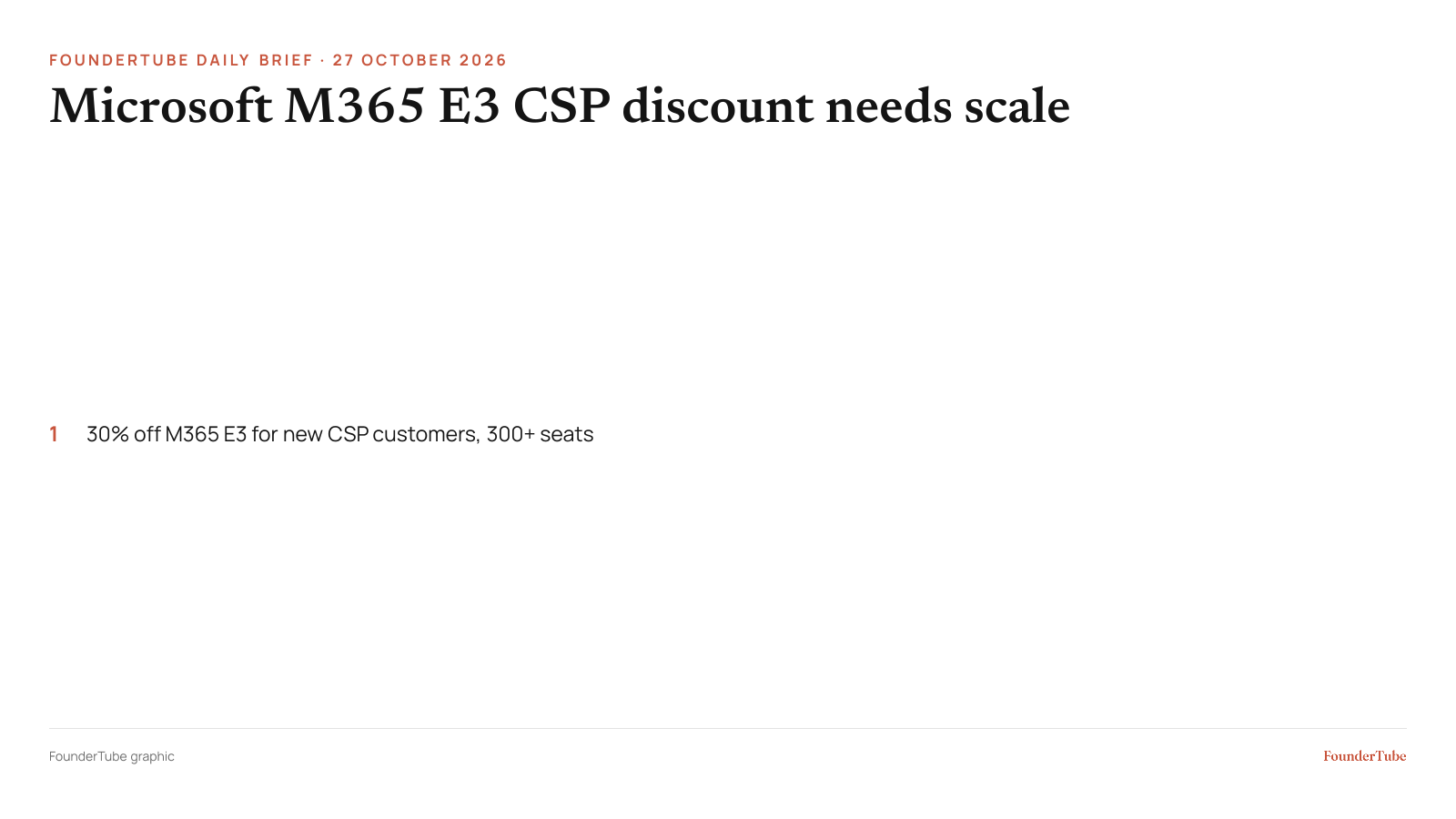
A rare 30% discount on Microsoft 365 E3 for 300+ new seats opens a budget window—useful if you’re buying at scale or selling into mid-market and enterprise.
What Microsoft is actually offering
Microsoft has announced a limited-time, 30% discount on the net partner price for Microsoft 365 E3 when purchased via the Cloud Solution Provider (CSP) program by eligible new customers who buy at least 300 new licenses. The offer runs from 27 October 2026 through 30 June 2027, requires an annual commitment, and allows either annual or monthly billing. Microsoft positions this to support upgrade conversations with customers on Office standalones or on-premises solutions, according to the Microsoft Learn Partner Center announcements.
Those are the facts that matter for founders: 30% off, CSP channel, 300-seat minimum, new eligible customers, one-year term, and a clear upgrade push. Everything else—eligibility specifics, price pass-through, and renewal terms—will depend on what your CSP partner offers you.
The thesis: great if you’re at scale; a non-event if you’re not
For most early-stage startups in India, a 300-seat floor puts this out of reach. But if you sell into mid-market or enterprise, expect procurement teams to revisit Microsoft 365 E3 upgrades during this window. That can shorten sales cycles, reshuffle budgets toward Microsoft-aligned stacks, and influence what gets funded in the next two quarters.
If you’re a startup buyer who expects rapid hiring that could cross 300 seats between now and 30 June 2027, timing your purchase could materially lower your run-rate on productivity tools for the first year. If you’re not going to hit 300, this isn’t the hill to climb; you’ll spend time negotiating for savings that the policy simply doesn’t extend to you.
Deconstructing the CSP discount: where the value lives
This is a discount on the net partner price, not a mandated end-customer price. Practically, it means your savings depend on your CSP’s margin structure. Some partners pass through most of the discount to win your business; others bundle services and support that change the total cost.
Because the offer requires an annual commitment but allows monthly or annual billing, you can smooth cash flow without changing your obligation term. That can help a growth-stage startup manage outflows while locking in the discount. But the commitment itself matters more than the billing cadence—understand what you’re on the hook for if headcount fluctuates during the year.
Microsoft frames the offer to support upgrades from Office standalones or on-premises solutions. If that describes your current setup, the discount is designed to make the shift to Microsoft 365 E3 more palatable inside your budget cycle, especially if you were already planning to modernise.
If you’re buying: three hard checks before you sign
Confirm eligibility and seat count in writing. The offer applies to “eligible new customers” and requires “at least 300 new licenses,” per the announcement. Ask your CSP to put eligibility and qualifying seat thresholds in your quote, including what constitutes “new” in your context.
Get the total cost on the net partner price baseline. Since the 30% is off the net partner price, ask for a transparent quote that shows the partner baseline and the discount flowing through to your end price. Clarify what’s bundled versus optional.
Understand the lock-in terms across the year. The offer requires an annual commitment. Clarify what happens if you need to add seats mid-term, whether reductions are allowed, and how pricing behaves at renewal after the first year.
Build a simple model: 300–500 seats over 12 months, with scenarios for 10% under/over expected headcount. Even if you don’t lock the exact numbers today, you’ll see the breakpoints at which the discount materially improves your run-rate versus alternative setups.
Timing headcount to the window
The offer runs from 27 October 2026 to 30 June 2027. If you are on a hiring plan that credibly crosses 300 seats in this period, align your purchase timing to the month you will actually use those seats. Because billing can be monthly, you can avoid front-loading cash outlays while still capturing the discount.
Two practical patterns we see founders wrestle with:
Near-threshold scale-up. You’re at 240–280 seats and have signed offers that take you beyond 300 by Q1 2027. If Microsoft 365 E3 was already your destination, moving the commit to the month you cross 300 seats can lock in the discount while keeping spend aligned to usage.
Step-change hiring. You plan a 100–150 seat expansion in one function (sales or support) across multiple cities. If that lift takes you from sub-300 to ~350, a single consolidated purchase could make the discount meaningful for year one of your expansion.
Don’t force a platform decision purely for a discount. If you’re below 200 seats with uncertain growth, flexibility typically beats a long commitment—even with a headline 30% off on a plan you don’t fully use.
If you sell B2B: align to this budget window
When a platform vendor creates a defined discount window, procurement wakes up. Your enterprise and mid-market prospects may now move E3 upgrades up the roadmap. That can pull forward adjacent purchases that make more sense post-upgrade.
Map your pipeline to this calendar. Think about where your product sits in a buyer’s journey if E3 is being adopted in the same quarter. Does your proof-of-concept look stronger once their base productivity and identity stack is refreshed? If yes, time your POCs to start just before the E3 decision to ride the same budget approval momentum.
Rework enablement material. If your product interoperates with standard Microsoft tenant constructs, ensure your sales materials explain workflows in post-upgrade environments without making assumptions about the buyer’s current stack.
Position as complement, not competitor. In an E3 upgrade cycle, buyers rationalise their stack. Show how you reduce operational friction or deliver outcomes alongside that upgrade instead of fighting the platform narrative.
Anchor to procurement mechanics. Enterprise buyers may batch software approvals. If E3 is heading to the board or CIO sign-off, piggyback your approvals into the same window and reduce one more cycle of legal-finance reviews.
Expect attention to snap to Microsoft discounts in Q3 FY27 timing and then diffuse after June. Your window to benefit from pulled-forward budgets is real but brief.
Negotiating with CSPs: what’s realistic
Because the discount is on the partner-side price, your end price is negotiated. In India, CSPs vary in how much of their margin they’ll sacrifice for a new, fast-growing account. If you can credibly show a path from 300 to 500+ seats within the year, say so. Partners like accounts that grow.
Keep the ask specific:
Pass-through of the full 30% on the base license. If not full, ask what services or support justify the delta.
Clarity on support SLAs and response times. If the partner bundles support, ensure those terms are written and measurable.
Quote hygiene. Seat counts, per-seat price post-discount, billing cadence (monthly vs annual), and any onboarding fees should be itemised.
Finally, guard against scope creep. If you’re moving from on-prem or standalone Office to a cloud suite, project time and internal change management costs can dwarf savings if you underestimate roll-out complexity. The discount helps; it doesn’t execute the migration for you.
Risks and guardrails
Two risks to watch:
Overcommitting seats. Annual commitments are unforgiving. Avoid over-ordering beyond a realistic near-term headcount unless you’ve modelled a high-confidence hiring plan.
Budget crowd-out. A large suite purchase can soak up discretionary IT budget for the year. If you’re also buying other critical tools, sequence decisions so you don’t starve teams of essentials.
On the seller side, avoid assuming the Microsoft discount will automatically accelerate your deals. It can create urgency but also introduce internal competition for budget inside your buyer’s org. Your role is to make your product the obvious “now” alongside the suite upgrade, not the afterthought.
Bottom line for founders
The Microsoft Partner Center announcement makes one thing clear: this 30% off M365 E3 via CSP is engineered for scale and for upgrade timing. If you’re buying and will cross 300 seats within the window, use it deliberately. If you’re selling into mid-market or enterprise, align your pipeline and messaging to the E3 upgrade calendar that procurement teams will be working to.
Don’t stretch to fit the deal; make the deal fit the plan.
Enjoying this story? Sign in to react and follow founders in your feed.
Something wrong with this article? Report it or request removal.